
Sometimes something bothers you, but you are not sure if it is worth bringing up.
Maybe someone made a comment that stayed with you. Maybe a conversation felt awkward. Maybe you want to respond, but you are not sure if you are reacting too quickly.
This free printable helps you pause before you send the text, start the conversation, or stay quiet for the wrong reason.
Do I Need to Say Something? is a simple reflection checklist for awkward moments, difficult conversations, boundaries, and situations that keep replaying in your mind.
What This Printable Helps With
This checklist helps you decide whether you need to:
Say something.
Set a boundary.
Wait until you are calmer.
Let it go.
Act differently next time.
It is not meant to make every small thing into a serious conversation. Some things really can be released.
But if something keeps bothering you, or if it is part of a repeated pattern, it may need attention.
When to Use It
Use this printable when you are asking yourself:
Should I bring this up?
Am I overreacting?
Is this a pattern?
Should I let it go?
Am I staying quiet because I am calm, or because I am afraid of their reaction?
It can help with partners, family, friends, school parents, coworkers, in-laws, or anyone you need to respond to carefully.
How to Use It
Think of one specific situation.
Then answer the 10 questions honestly. Do not try to solve the whole relationship. Just look at the moment in front of you.
After that, choose the answer that fits best:
I need to say something.
I need to set a boundary.
I need to wait until I am calmer.
I can let this one go.
I do not need a conversation, but I need to act differently next time.
Then write one small sentence you can actually say.
Not a speech. Not a long explanation. Just one honest sentence.
For example:
“That comment bothered me.”
“I need to say no to that.”
“I want to talk about this when I’m calmer.”
“I don’t need a big conversation, but next time I’ll handle it differently.”
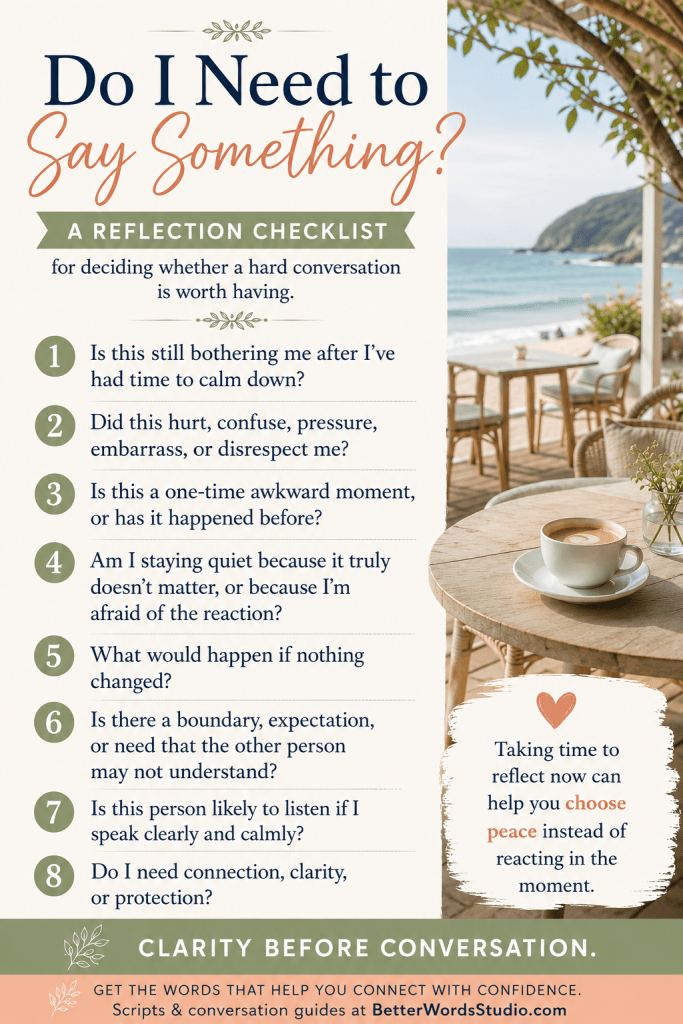
Use this checklist the next time you are stuck between saying too much and saying nothing.
It can help you choose your words from a calmer place.
Peace is not always staying quiet. Sometimes peace starts with saying the true thing calmly.
 Better Words Studio
You must be logged in to post a comment.