
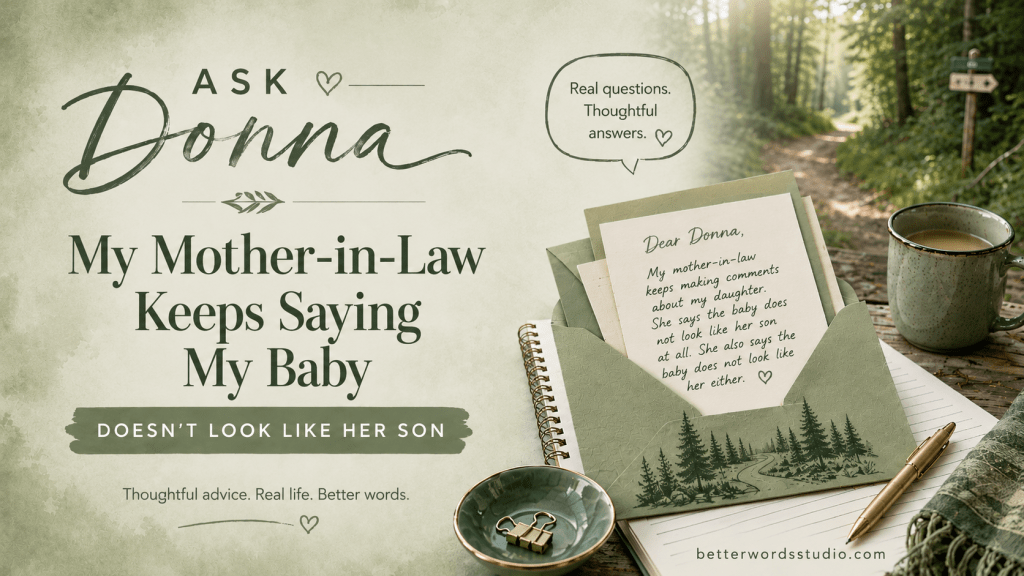
Comments about who a baby looks like are usually harmless. But when someone keeps saying your baby does not look like your husband, the comment stops feeling cute. It starts feeling like suspicion dressed as small talk.
The Letter
Dear Donna,
My mother-in-law keeps making comments about my daughter.
She says the baby does not look like her son. She also says the baby does not look like her side of the family. At first, I tried to laugh it off. I said things like, “Babies change so much,” or, “She looks like me.”
I thought she was being awkward.
But she has said it more than once, and recently it felt pointed. She kept saying the baby did not look like my husband’s family. I got upset and said, “I am sure she is his child.”
She laughed and did not apologize.
For the record, this is absolutely my husband’s child. But her comments make me feel humiliated. It feels like she is implying something ugly while pretending it is harmless.
My husband was there and did not say much. Watching him stay quiet while his mother says this breaks my heart.
Now I keep replaying it. I feel hurt enough to wonder if cutting contact is the only answer.
Am I overreacting? What do I say when she makes these comments?
Signed,
N.
Donna’s Answer
No, you are not overreacting.
Let us remove the decorative wrapping paper from this comment.
When a mother-in-law keeps saying, “This baby does not look like my son,” after you have already responded with discomfort, she is not making innocent baby small talk anymore.
She is poking at legitimacy.
She might not be brave enough to make the accusation directly, so she tosses it into the room, laughs, and waits for you to look unreasonable.
Charming. Subtle. Terrible use of grandmother energy.
A baby’s face is not a courtroom exhibit.
Your child’s place in the family is not a guessing game.
What Is Really Happening
This kind of comment cuts deep because it attacks several things at once.
It attacks your dignity as a wife.
It attacks your safety as a mother.
It attacks your child’s place in the family.
It also creates a social trap. If you get angry, she gets to say, “I only said she does not look like him.” If you stay quiet, the implication sits in the room like a dirty little fog.
That is why you feel shaken afterward.
Your body understands the insult, even if everyone else wants to pretend it was nothing.
Normal baby-look comments are light. “She has your eyes.” “She looks like her sister.” “Babies change so much.” Those comments pass through the room and leave no bruise.
This is different.
It is repeated. Pointed. Personal. And when you answered clearly, she kept going.
That is the part that matters.
Once someone knows a comment hurts you and repeats it anyway, it is no longer an accident.
What To Remember
You do not need to prove her motive before setting a boundary.
Maybe she feels possessive of her son.
Maybe she wants the baby to look like her side of the family so she feels ownership.
Maybe she wants a reaction.
Maybe she hides cruel comments behind laughter, like a toddler hiding behind a curtain with both feet showing.
Or maybe she is implying something darker.
You do not need to solve her inner life before saying, “Stop.”

What To Say Next Time
Script 1:
“Please do not say that again. It sounds like you are questioning whether she is your son’s child.”
Script 2:
“You have said that several times. I do not find it funny, and I do not want comments like that made about my child.”
Script 3:
“Whether she looks like your side or not is not something we need to keep discussing.”
Script 4:
“My daughter’s identity is not up for debate.”
Script 5:
“If this topic comes up again, we will end the visit.”
Use the first script when you want to name the implication clearly. Use the second when you want to focus on the repeated behavior. Use the third when you want a calm exit. Use the fourth when she needs a stronger boundary. Use the fifth when the boundary needs a consequence.
If she says, “That is not what I meant,” say this:
“Good. Then there is no reason to keep saying it.”
That sentence is clean. It gives her the benefit of the doubt and closes the door.
If she says, “You are too sensitive,” say this:
“I am her mother. I am allowed to be sensitive about comments that disrespect my child.”
If she laughs, do not laugh with her.
Say:
“I heard you. I am asking you to stop saying it.”
What Not To Do
Do not laugh it off anymore.
The laughter stage is over. The diplomacy snack tray has been removed.
Do not debate genetics at the dinner table.
You do not need to compare noses, eyes, baby pictures, or family traits. That keeps her game alive.
Do not wait for your husband to magically understand the exact sentence you need.
Give him one small job.
Say to him privately:
“When your mother says this and you stay silent, I feel alone. Next time, I need you to say, ‘Mom, stop. She is my daughter.’”
He does not need to give a grand speech. He needs one clear sentence.
“Mom, do not say that again. She is my daughter.”
That is enough.
Do not jump straight to cutting contact before you state the boundary and consequence clearly.
Start here:
“If you make that comment again, we will end the visit.”
Then follow through.
No debate. No crying in the bathroom.
Gather the baby. Leave the room. End the call. Go home.
A calm consequence teaches faster than a long explanation.
Donna’s Final Word
Your mother-in-law does not get to sprinkle suspicion over your baby and call it conversation.
Your daughter is not a face-comparison project for a grown woman with poor emotional hygiene.
Say it once. Say it clearly. Then let the consequence do the talking.
A fence is not rude when someone keeps walking through the garden.
 Better Words Studio
You must be logged in to post a comment.