
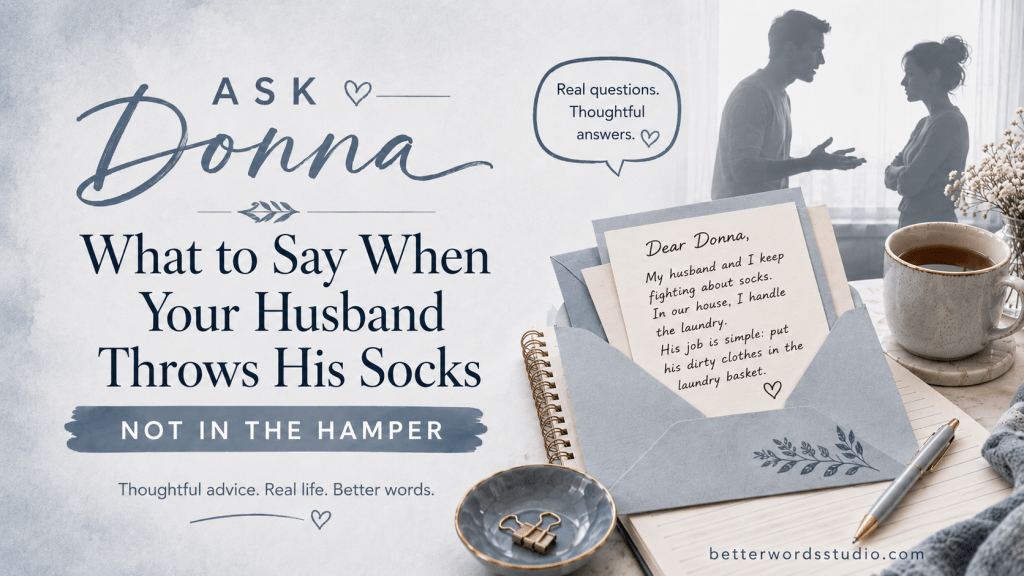
A sock fight is rarely about the sock. It is about one person creating a small problem again and again, then blaming the person who already does the work. The hamper is not a suggestion. It is about respecting the invisible work.

The Letter
Dear Donna,
My husband and I keep fighting about socks.
In our house, I handle the laundry. I wash, dry, fold, sort, and put things away. His job is simple: put his dirty clothes in the hamper.
The problem is that he tosses his socks and clothes toward the basket instead of putting them inside. Sometimes they land inside, sometimes they land behind it or beside it.
I have asked him many times to put his clothes inside the hamper. He says he understands. Then he forgets and throws them again.
When I do laundry, I wash what is in the hamper. I do not always notice the socks behind it. Then his socks do not match, and the same fight happens again.
Last week, I warned him again. A few days later, he did it again. When I folded the laundry, I matched my socks neatly but shoved his socks into his drawer unmatched. I know it was petty. I was tired.
The next morning, he could not find matching socks and got angry. He said I was childish and overreacting to something small. He said he made a mistake from habit, not on purpose. He also said it would not be hard for me to check before washing.
Is he right that I handled it childishly? Or am I allowed to be furious that he creates the sock problem and then blames me for not solving it?
Signed,
B.
Donna’s Answer
Ah, socks.
The tiny cotton ambassadors of marital resentment.
Let us begin with the obvious: this fight is not about socks.
It is about a man creating a problem with his own habit, then acting shocked when the household fairy fails to repair it.
And by household fairy, I mean you. The woman doing the laundry.
Was shoving his socks into the drawer unmatched petty?
Yes.
Was it understandable?
Also yes.
What Is Really Happening
Your reaction was not perfect, but his argument is worse.
He is turning his failure to do the first step into your failure to do an extra step.
He throws the socks near the hamper.
The socks fall behind the hamper.
You wash what is in the hamper.
He has no matching socks.
Then somehow the lesson becomes: YOU should pay more attention.
No, sir.
A missed sock happens. Everyone misses laundry sometimes. A sock hides in a sleeve. A towel stays in the washer too long. A child’s shirt reappears behind the couch like it spent six weeks at a wellness retreat.
That is life.
But this is not one missed sock. This is a repeated pattern.
You named the problem. He understood the problem. He kept doing the thing that creates the problem. Then he criticized the person doing the chore when the predictable result arrived.
That is why you feel furious.
When someone says, “It is a habit,” they often expect the other person to absorb the consequences forever.
Habit explains the behavior. It does not excuse the transfer of work.
What To Remember
Laundry is not one task. It is a chain.
Collecting.
Sorting.
Washing.
Drying.
Folding.
Pairing.
Putting away.
Remembering what needs care.
Keeping the house from becoming a damp textile museum.
When he says, “Check behind the hamper,” he is adding another invisible step to the person already doing the whole chain.
What To Say Next Time
Script 1:
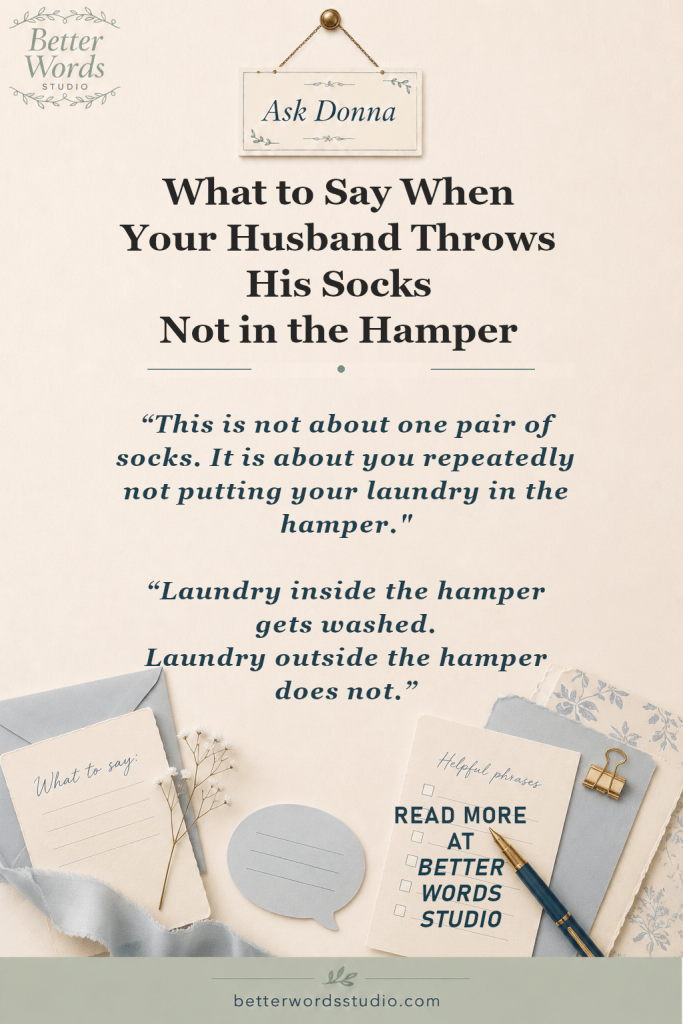
“This is not about one pair of socks. It is about you repeatedly not putting your laundry in the hamper, then blaming me when it does not get washed.”
Script 2:
“I am happy to wash laundry that is in the hamper, but I am not going to search behind it for your socks.”
Script 3:
“I understand it is a habit. It still creates extra work for me, so it needs to change.”
Script 4:
“If checking behind the hamper is easy, putting the socks inside it is easier.”
Script 5:
“From now on, laundry inside the hamper gets washed. Laundry outside the hamper waits until it is inside.”
Use the first script when he says the issue is small. Use the second to set the boundary. Use the third when he hides behind habit. Use the fourth when he tries to add work to your task. Use the fifth as the new household rule.
What Not To Do
Do not keep arguing about whether socks matter.
Of course socks are small. The pattern is not.
Do not keep using petty protest as your main language.
The unmatched sock drawer made a point, but it also gave him a way to make your reaction the headline.
Retire that method.
A clean boundary is stronger than a petty message.
Do not hunt for laundry outside the hamper.
No checking behind it. No searching beside it. No rescue mission for socks with poor aim.
Say the rule once, calmly:
“Laundry inside the hamper gets washed. Laundry outside the hamper does not.”
Then follow the rule.
No lecture. No revenge. No dramatic sock burial ceremony.
Natural consequence only.
If he wants matched socks, he has options. He may put both socks inside the hamper. He may match his own socks. He may buy identical socks.
He does not get to keep throwing socks, ignore your requests, and criticize you.
Donna’s Final Word
The person who misses the hamper does not get to complain that the hamper-based laundry system failed him.
Growth comes in many forms. Sometimes it wears one black sock and one gray sock.

 Better Words Studio
You must be logged in to post a comment.