
It hurts when someone mocks your mother. It hurts more when the person doing it is your husband, and your mother adores him. This is not about defending every mistake your mother makes. It is about asking your husband to respect her dignity.
The Letter
Dear Donna,
I have been married for a little over three years. My husband is smart, successful, and highly educated. He grew up around educated people, and people often praise him for his achievements.
My family background is different. My mother did not go far in school, and she has always been sensitive about education.
My mom adores my husband. She is proud of him and talks about how smart he is. That makes this painful.
Sometimes my mom says something incorrectly, misunderstands a financial or social topic, or does something my husband sees as unsophisticated. He usually says nothing at the time. Later, when we are alone, he laughs about it.
He makes general comments about “uneducated people” or people who make foolish choices. When I ask if he is talking about my mom, he acts surprised and says he forgot she did the same thing. I do not believe him.
Outside of this issue, he is a good husband. He is affectionate and supportive, so I do not want to make him sound awful.
But I feel like he looks down on my mother, and maybe on my background. I have started visiting my mom without him because I do not want to hear his comments afterward. Now my mom asks why he does not come around as much.
How do I talk to him when he keeps escaping with “I did not mean it,” “I forgot,” or “sorry, never mind”?
Signed,
T.
Donna’s Answer
Oh, this one stings.
It stings because your mother stands there with welcoming arms and a proud smile, while your husband quietly files her under “uneducated people”.
That is an ugly feeling.
And I believe you when you say he is loving in many ways. People are complicated. A man might be tender to his wife and still have a nasty little class-snobbery drawer in his personality.
We are opening the drawer.
We are not burning down the house.
What Is Really Happening
This is not about one wrong phrase or one confused comment.
Your husband’s problem is not that he notices your mother’s mistakes.
The problem is that he stores her mistakes, polishes them, and later serves them to you as private entertainment.
That is the part that feels cruel.
A passing observation is one thing. A pattern of mocking your mother’s intelligence, education, judgment, or manners is another.
And when you call him on it, he hides behind, “I forgot your mom did that.”
Oh, please.
He might not be planning a formal attack on your mother. But he knows the association now. He knows these comments hurt you. From this point forward, “I did not mean it” is not enough.
What To Remember
Your mother’s education is not a random fact. It is part of your family story. It carries sacrifice, insecurity, pride, shame, ambition, and love.
So when your husband laughs at her, it feels like he is laughing at the soil you grew from.
He thinks he is saying, “Your mom said something silly.”
You hear, “People like your mom are beneath people like me.”
That is why the wound feels bigger than the comment.
You do not need to convince him your mother is perfect.
She is not. No mother is.
She might misunderstand things. She might make poor choices. She might say something embarrassing. She still deserves respect.
The boundary is not, “You must admire my mother’s judgment.”
The boundary is, “You do not mock my mother to me.”
What To Say Next Time
Script 1:
“I need to talk about something that has become a pattern. When my mom says something wrong or does something you think is unsophisticated, you bring it up later and laugh. It no longer feels accidental.”
Script 2:
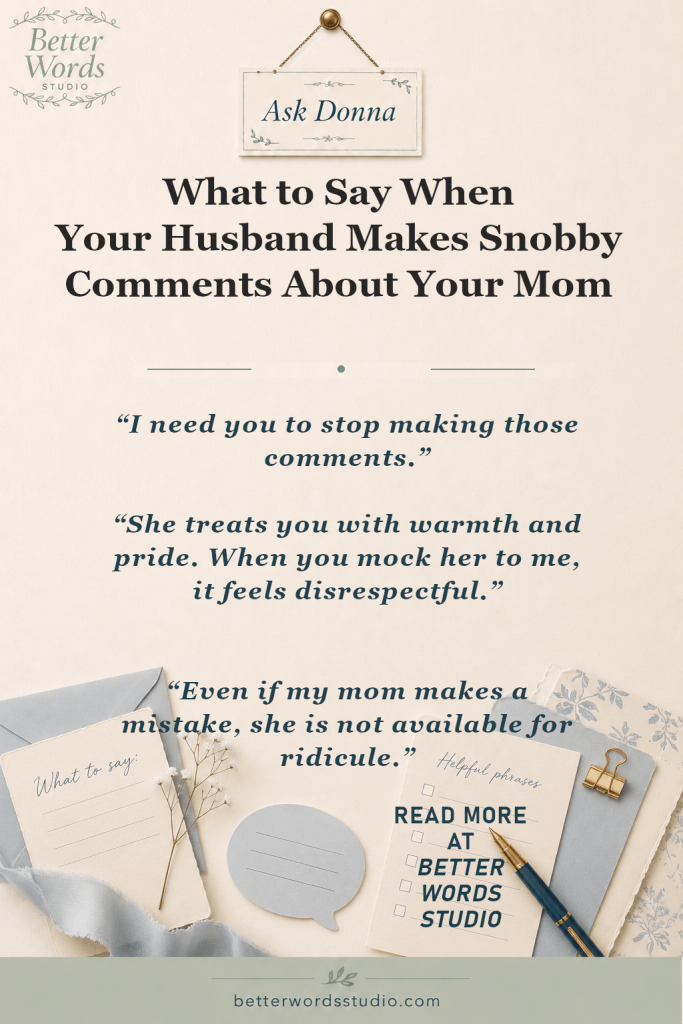
“I know my mom is not perfect. I am not asking you to pretend she is. But she treats you with warmth and pride. When you mock her to me, it feels disrespectful.”
Script 3:
“It makes me feel like you look down on the family I came from. I need you to stop making those comments.”
Script 4:
“You might not mean to hurt me. But it does hurt me, and now that I have explained it, I need the pattern to change.”
Script 5:
“Truth is not a license to be cruel. Even if my mom makes a mistake, she is not available for ridicule.”
Use the first script to name the pattern. Use the second to keep the conversation fair. Use the third to name the deeper hurt. Use the fourth when he says he did not mean it. Use the fifth when he tries to defend the comment because it was “true.”
What Not To Do
Do not start the full conversation right after he makes a comment.
In that moment, you are hurt, he is slippery, and the whole discussion will become a debate over one sentence.
Choose a calm time.
Do not let him escape into general comments.
If he says, “I was not talking about your mom,” say:
“When you make a general comment that clearly overlaps with something my mom did, I experience it as a comment about her. I need you to stop making those remarks around me.”
Do not rush to soothe him if he apologizes.
Say:
“Thank you. What I need is for this to change going forward.”
Do not keep silently managing his relationship with your mother.
Tell him:
“I have been visiting my mom alone more because I do not want to hear comments about her afterward. I do not want that distance to keep growing, but I need you to understand why it is happening.”
He needs to know his behavior is changing family life.
Do not confuse respect with admiration.
He does not need to worship your mother, agree with her, or see her as wise in every situation. He needs to stop using her as a private example of people who “do not know better.”
Donna’s Final Word
Your husband might be loving, generous, smart, and supportive.
He also might be acting like a snob.
Being good in many areas does not give him a coupon for cruelty in this one.
Tell him plainly: “I need you to respect my mother’s dignity, even when you do not respect her judgment.”
 Better Words Studio
You must be logged in to post a comment.