
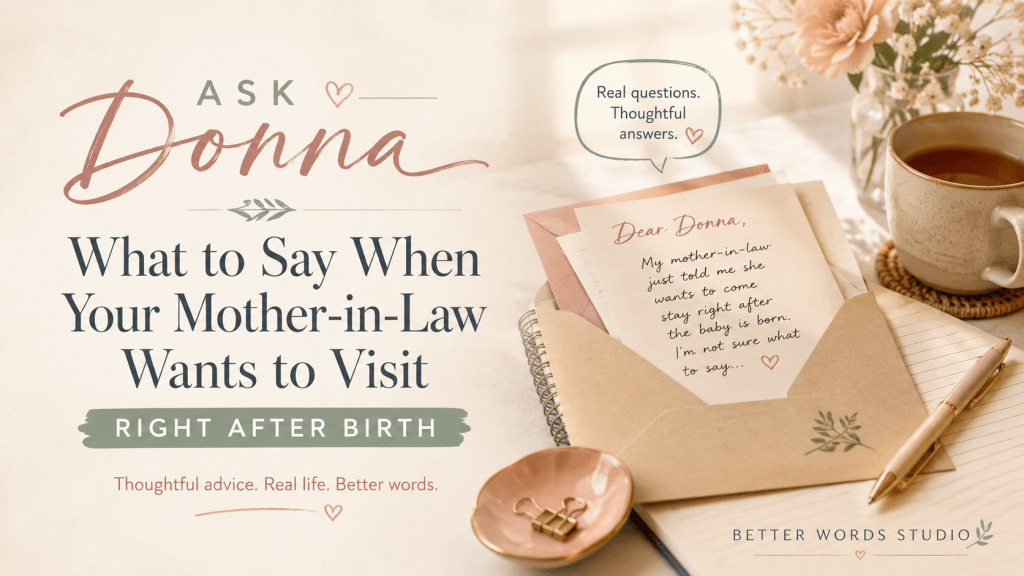
A new baby brings joy, love, hormones, laundry, and relatives with eager calendars. When your mother-in-law wants to visit right after birth, the problem is not the excitement. The problem is the pressure on a recovering mother to become socially available before she feels human again.

The Letter
Dear Donna,
I had a baby, and within a day, my mother-in-law started asking when she would get to visit and see the baby. I understand her excitement. This is her grandchild, and I know she means well.
But I did not want visitors. I wanted to rest, recover, learn how to feed my baby, cry when I needed to cry, and not worry about looking pleasant in pajamas.
My husband thought a short visit would be fine. He said his mom was excited and meant well. Every time he brought it up, I felt tense and resentful.
Part of me felt guilty. Part of me felt protective. I also wondered if I felt this strongly because it was his mother. If it had been my own mom, I might have felt differently.
What should I have said? How do I protect my recovery without becoming the difficult daughter-in-law right away?
Signed,
T.
Donna’s Answer
Hi T,
First, let us honor the timing here.
You had a baby. You were not hosting brunch.
There is a strange little social glitch around childbirth. Everyone agrees the mother has done something enormous, then asks her to receive guests as if she opened a tiny newborn welcome center.
Wanting privacy was not rude. It was sane.
What Is Really Happening
This is not just about a visit.
This is about being seen before you feel put back together.
After birth, a visitor is not always a visitor. Sometimes a visitor means sitting up, smiling, covering your body, explaining the baby’s feeding, answering questions, and pretending you feel more human than you do.
That is work.
With your own mother, you might feel free to cry, bleed, snap, sleep, smell strange, or point at a laundry basket. With a mother-in-law, even a kind one, you might feel polite. You might feel watched. You might feel judged before anyone judges you.
That difference matters.
The deeper issue is this: a new baby makes everyone emotional, but only one person is recovering from birth.
Grandparents feel excitement. Fathers feel pride. Relatives feel curiosity. Everyone wants a moment.
But the mother is living inside the moment. Her body is healing. Her sleep is broken. Her identity has shifted overnight. Her home no longer feels like a normal home. It feels like a recovery room, feeding station, laundry pile, and sacred cave.
So when your mother-in-law asked to visit, you were not only reacting to a visitor.
You were reacting to being seen before you felt put back together.
You were reacting to the pressure to perform happiness.
You were reacting to the fear of being judged in your most vulnerable state.
You were reacting to the feeling of, “I gave birth, and somehow I still have to manage everyone else’s feelings.”
That is the part people miss.
You did not want to punish your mother-in-law. You wanted to stop being socially available.
And yes, the mother-in-law part matters.
Many women feel different about their own mother visiting after birth than their mother-in-law visiting. This does not mean you dislike your mother-in-law. It often means your body knows the difference between being cared for and being watched.
With your own mother, you might feel free to cry, sleep, smell strange, hand her laundry, and say, “Please bring me water.” With a mother-in-law, even a kind one, you might feel polite. You might feel observed. You might feel the need to sit up straighter, smile more, and explain more.
That extra layer counts.
What To Remember
Postpartum visitors should reduce the mother’s burden, not become one more burden.
If someone enters the house and you have to host, reassure, entertain, update, clean, smile, or manage their feelings, that person is not visiting. That person is work wearing a cardigan.
Your boundary was not about excluding people.
It was about recovering.
That is the sentence to keep.
What To Say Next Time
Script 1:
“We are keeping the first few days quiet while I recover and we settle in with the baby. We’ll let you know when we’re ready for a visit.”
Script 2:
“I know everyone is excited to meet the baby. Right now I need rest and privacy. We’ll plan a visit once I feel more steady.”
Script 3:
“I’m not up for visitors yet. I need time to heal and adjust. Thank you for understanding.”
Script 4:
“I know your mom is excited. I’m glad she loves the baby. But I need you to protect my recovery right now, not negotiate it.”
Script 5:
“Mom, we’re keeping things quiet while everyone recovers and settles in. We’ll invite you over when we’re ready. We know you’re excited, and we appreciate your patience.”
Use the first three scripts with relatives. Use the fourth with your husband. Use the fifth as language your husband gives his mother, so he does not accidentally turn you into the villain in a family group chat.

What Not To Do
Do not overexplain.
New mothers often overexplain because they want to prove their boundary is fair. You do not need to prove exhaustion.
Do not give a full medical report.
Your bleeding, stitches, feeding struggles, hormones, and sleep deprivation do not need to become evidence in a family trial.
Do not let your husband frame it as your personal rejection of his mother.
He should say, “We are keeping things quiet,” not, “My wife does not want visitors.”
“We’re not ready for visitors yet.”
That is enough.
If she pushes, stay calm and repeat the same point.
“I appreciate that, but I’m still not ready.”
“I know you mean well. I still need privacy right now.”
“I understand this feels disappointing. We are still waiting until I feel ready.”
Her disappointment is allowed. Your recovery still comes first.
Donna’s Final Word
You were not wrong for needing privacy before politeness.
A baby was born, yes. But a mother was born too.
New mothers deserve a little quiet before the parade starts.
 Better Words Studio
You must be logged in to post a comment.