

Quitting smoking is hard enough without a coworker turning your break into a progress meeting. When support starts to feel like pressure, you need a calm boundary. You do not owe the break room a weekly report on your lungs.
The Letter
Dear Donna,
I have been trying to quit smoking for a long time. I have quit before, for weeks, months, and once for almost a year. Then stress hits, I tell myself, “one cigarette,” and the whole pattern starts again.
Recently, I told a coworker I wanted to quit again. Saying it out loud felt hopeful. Another coworker overheard me. We are friendly, but not close.
She told me she quit smoking a few years ago. I said I was happy for her. Since then, she keeps checking on me. She asks how quitting is going, whether I am still smoking, and why I am smoking if I said I wanted to stop.
I think she believes she is helping. She feels proud of her own quit story and wants to encourage me. But her questions make me feel watched and embarrassed. Now every cigarette feels like a public failure.
Part of me wants to say, “Please leave me alone.” Part of me feels rude because she did quit successfully and means well.
How do I tell her to stop without making it dramatic?
Signed,
R.
Donna’s Answer
First, congratulations on still trying.
Not because you gave a perfect speech. Not because you became a glowing wellness influencer who drinks cucumber water beside a sunrise.
Because you are still trying.
That counts.
Now let us deal with your coworker, who has accidentally appointed herself Minister of Your Lungs.
I believe she means well. Many irritating people mean well. That is what makes them so durable.
She quit smoking, which is impressive. But she is doing a human thing people do after they get through something hard. They reach the finished side and forget the chaos of the middle.
From the finished side, quitting looks simple.
From the middle, it feels like wrestling a raccoon in your nervous system while answering work emails.
You told someone about a hard personal goal. You did not enroll in coworker-supervised lung management.
H3: What Is Really Happening
This is about smoking, and it is also about being witnessed before you feel finished.
When you say, “I’m quitting,” you show people a hopeful version of yourself. You are saying, “I want to become someone different.” That is vulnerable. It is not office small talk about the coffee machine.
Then, when you struggle, the gap feels visible. You see the person you wanted to be, and the person holding the cigarette today.
That gap already hurts.
When someone keeps pointing at it, even with a caring face and a reusable water bottle, it starts to feel like shame.
Shame is a terrible quitting strategy. If shame worked, the world would be thin, sober, organized, debt-free, and caught up on laundry. Humanity would be unbearable but efficient.
Your coworker also might be using your quitting journey to replay her own success. She gets to stand in the identity of the person who conquered it.
That does not make her evil. It makes her human.
But you are not a mirror for her proudest self. You are a person in process.
There is a difference between support and performance-support.
Real support asks, “What helps you?”
Performance-support says, “I will now coach you because your struggle reminds me I won.”
No thank you. Clipboard returned.
What To Remember
You do not owe coworkers access to your self-improvement projects.
You get to be friendly without being fully transparent.
You get to protect a fragile goal while it is still forming.
A coworker who means well still needs boundaries. Intention does not erase impact.
Her intention might be encouragement.
The impact is pressure.
Both things fit in the same room. Your boundary still gets a chair.
What To Say Next Time
Script 1:
“I know you mean well, but I’m trying not to talk about quitting at work. It makes me feel more stressed.”
Script 2:
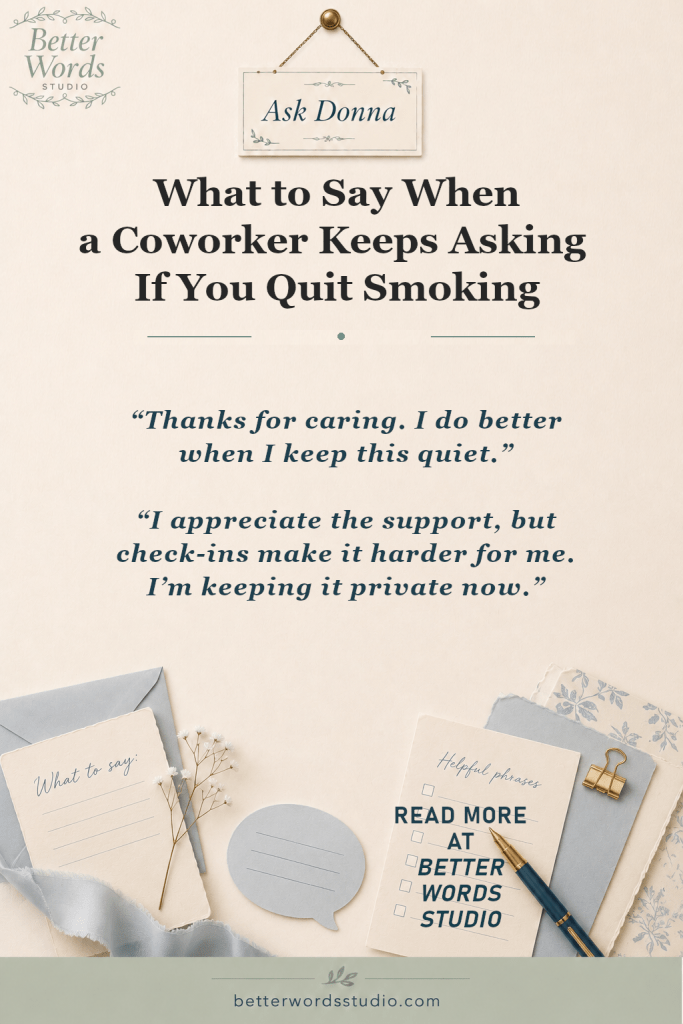
“I appreciate the support, but check-ins make it harder for me. I’m keeping it private now.”
Script 3:
“Thanks for caring. I do better when I keep this quiet, so I’m not giving updates.”
Script 4:
“I’m not discussing this at work.”
Script 5:
“I’m still working on it. I’m keeping it private.”
Use the first script when you want warmth. Use the second when you want more clarity. Use the third when you want a softer exit. Use the fourth if she keeps asking after you set the boundary. Use the fifth if she catches you smoking and makes a comment.
What Not To Do
Do not apologize for needing privacy.
You did not create a workplace emergency by wanting less commentary.
Do not give her your full quit timeline.
She does not need your stress level, your cigarette count, your relapse history, your plan for next week, and a pie chart.
Do not comfort her for making you uncomfortable.
If she says, “I’m trying to help,” say this:
“I know. I’m telling you what helps me.”
That is enough.
Do not let one nosy coworker ruin the whole attempt.
A difficult moment does not erase effort. A cigarette does not turn you into a failure. It tells you a stress point needs a better plan.
Say this to yourself:
“I smoked today. I am still trying.”
Then keep going.
Donna’s Final Word
You are not rude because you want privacy.
You are not weak because quitting is hard.
Your lungs are not a workplace group project.
Keep the goal, lose the audience.

 Better Words Studio
You must be logged in to post a comment.